
Why Your Team Follows the Process But Still Fails the Customer
Friday, November 13, 2026
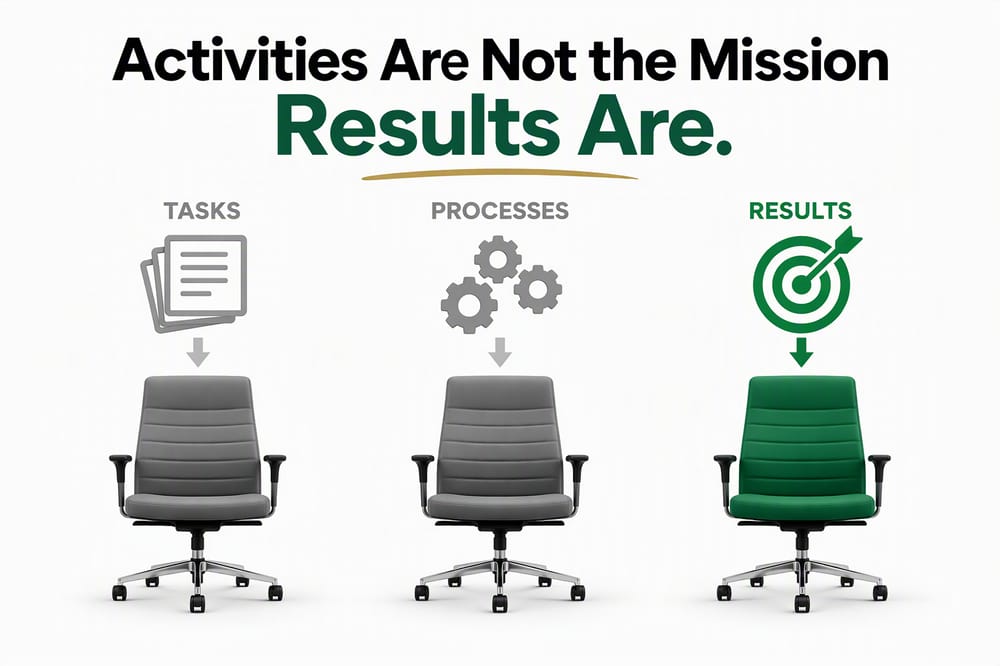
The frustrating part about many leadership problems is that everyone can be working hard, following the process, and doing exactly what they were trained to do, yet customers are still disappointed, opportunities are still missed, and leaders are left wondering why execution feels so inconsistent. In most cases, the issue isn't effort. It isn't talent. It's that somewhere along the way, people started believing their job was to complete tasks instead of owning a result.
This isn't a conversation about eliminating process. Good companies need process. In fact, the better your company gets, the more important process becomes.
The challenge is making sure the process remains a tool rather than becoming the Mission. When people are clear about the result they own, they can use the process wisely. When they aren't, they tend to follow the process even when it no longer serves the outcome you're trying to achieve.
When Doing the Job Still Produces the Wrong Outcome
Recently, I had two customer experiences that couldn't have been more different.
In the first situation, an order arrived with an item missing. I contacted the company, explained the situation, sent a quick photo of what I had received, and a replacement was on its way. Within a few days, the issue was resolved.
Simple.
The second experience involved a much larger company. A product I ordered never arrived. After multiple conversations with customer support, multiple explanations of the same problem, and multiple assurances that everything would be taken care of, I still didn't have the product and was staring at notices suggesting I might be charged for something I never received.
Here's what struck me. The people I spoke with at both companies were polite. The people at both companies appeared to be following a process. The difference was that one company solved the problem and the other worked the process.
That's an important distinction.
Because from the inside, everyone involved may have felt they did their job well. The customer service representatives answered questions. They followed procedures. They escalated issues when necessary. They checked the boxes required of them.
But only one company delivered the result.
The Hidden Moment When Process Becomes the Job
This is something I see with growing companies all the time. As organizations grow, they naturally create systems, procedures, and standards. That's a good thing. It's how you scale beyond a handful of people carrying everything in their heads.
Without process, growth becomes chaos. But there is a risk. Over time, people can begin to confuse the process with the purpose. The process was originally created to produce a result. Yet somewhere along the way, the process itself becomes the definition of success.
People start asking:
"Did I follow the procedure?"
Instead of:
"Did we achieve the outcome?"
That subtle shift changes everything.
When process becomes the job, employees naturally measure themselves by how well they followed the steps. When results become the job, employees measure themselves by whether the customer, teammate, or business is actually better off because of their work.
Those are two very different ways of thinking.
Why Results Ownership Changes Decision Making
At Results On Purpose, we spend a lot of time helping leadership teams define Results Owned.
Every seat exists for a reason. Every role should have one or more clear results that justify why that seat exists in the first place. Notice I said results. Not activities. A sales leader doesn't exist to make calls. A sales leader exists to own the sales result. An operations leader doesn't exist to run meetings or manage tasks. They exist to own operational results such as customer retention, service delivery, quality, or profitability.
The activities matter. But they are not the Mission. They are simply the path toward the Mission. When someone clearly understands the result they own, their thinking changes. Instead of asking, "What step comes next?" they start asking, "What would best achieve the result we want?" That shift produces better decisions, especially when situations don't fit neatly into a process.
And let's be honest.
Most leadership challenges don't fit neatly into a process.
The Difference Between Activities and Results
One of the most common patterns I see with leadership teams is that people can describe everything they do. They can walk you through meetings, reports, approvals, conversations, systems, and responsibilities in great detail. But when I ask a simpler question, the room often gets quiet.
"What result does your seat exist to produce?"
That's usually a harder question. Not because leaders don't care. Not because they're not effective. Simply because most organizations spend more time discussing activities than results. The result is that people become experts in what they do but less clear about why they do it. That's where alignment begins to break down.
Because activities create motion.
Results create focus.
Activities keep people busy.
Results create accountability.
Activities fill calendars.
Results move businesses forward.
When people know the result they own, priorities become clearer. Decision-making becomes faster. Accountability becomes more objective. Most importantly, people begin to think like owners.
Results Owned Starts With Leadership
This doesn't begin on the front line. It begins with leaders. Leadership teams set the tone for how everyone else thinks. If leaders define success by activity, everyone else will too. If leaders define success by results, people throughout the organization begin doing the same.
That's one of the reasons we focus so heavily on clarity.
Clarity creates freedom.
When a leader understands the result they own, they don't need a rule for every situation. They can make sound decisions when circumstances change. Their teams begin learning how to think rather than simply what to do. That is a significant difference.
Growing companies need capable leaders, not just capable task managers.
They need people who can navigate ambiguity, solve problems, and make decisions that advance the Mission even when the playbook doesn't perfectly fit the situation. That only happens when results are clear.
Why Does Your Seat Exist?
Here's a question worth considering.
If I walked into your company tomorrow and asked each person why their seat exists, what would I hear?
Would they explain the process they follow? Or would they clearly describe the result they own? The answer tells you a lot about the culture you're creating. Because when people understand the result they own, they become more engaged, more accountable, and more effective.
They stop hiding behind process.
They start taking responsibility for results.
And that's where real organizational growth starts. Not with more systems. Not with more procedures. Not with another layer of complexity. It starts when people understand the Mission, take ownership of the result, and make decisions that build trust, create alignment, and move the business forward.
The best companies have processes.
Great companies never let the process become more important than the result.

Hi, I Am Jeff Garrison
Founder of Results On Purpose Coaching
As business coaches working with leadership teams of companies large and small in a variety of industries, we see similar patterns in all of them. Here we try to take those observations and convert them to nuggets of entrepreneurial leadership wisdom.
